The camera only captures what it sees – Comment on Matt Forde’s blog in 2010
1970
[I confess I remember nothing of this day, apart from the few snaps he took. This one still here to remind me that yes, he was there.]
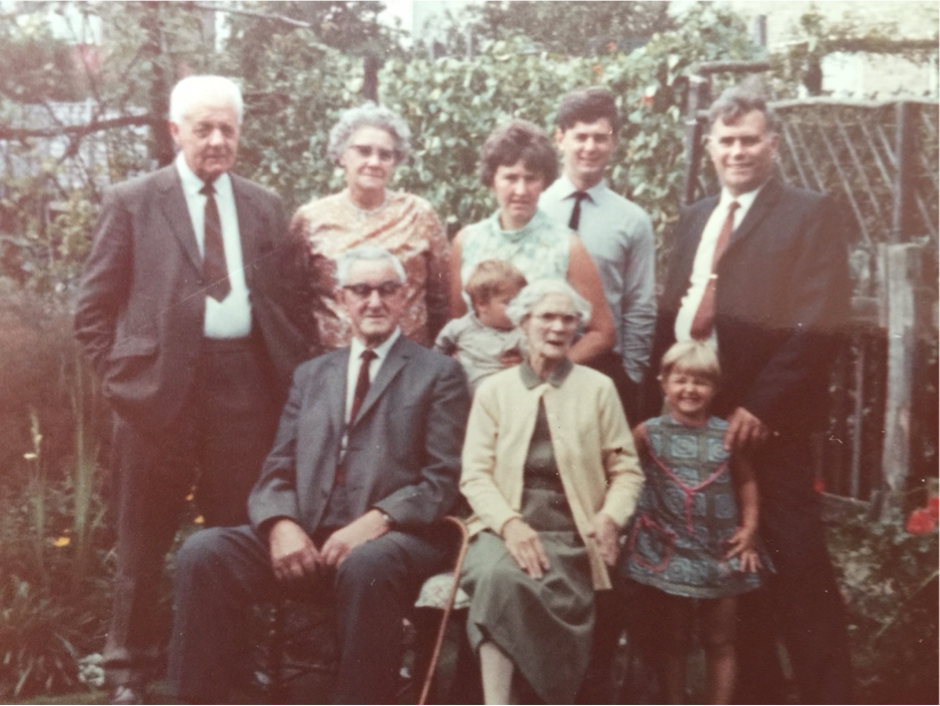
Like memory, the colours have faded and the photo is out of focus. But four generations are present. Grandparents, father, auntie and her husband; my brother, wife and children. It’s Diamond Wedding day, 8 September 1970.
Me? I have just emerged from twenty years “in care”. Finally escaping from my seventh foster-mother’s coercive control by marrying a French woman and decamping to that country. Just one week ago. This is only the second week of my true self and at 23 I’m not proud of the twenty years it has taken me to engineer my escape. So why was I back so soon?
[The baby of a post-war reconciliation, he failed. The marriage collapsed when he was three.]
1986
– He was vain, my brother says of our dead father.
I am intrigued. Not a word I would have used. But then I didn’t know my own father did I.
– More like feckless? I counter [Judging by his police record, which he will read later.]
– Whatever. He was transgressing when you were children, chips in my sister-in-law.
Such a prim word for betrayal I thought, and somewhat menacing in content.
– He was never there and always out late, brother recalls. I think he was already seeing the other woman.
I’ve never heard him talk about that before. Certainly, we both still remember the violence and the lies in the small caravan. Bought out of our grandparents’ savings. Their third attempt at shoring up the failing marriage.
1953
[Where he was now six.
– I always have strawberries on my birthday, he will tell everyone forever after.
His last memory of the family together. It was something to hang on to.
It’s 1953 and wow, his Mum divorces their Dad for mental cruelty.
2007
I see he’s been careless with the camera. Curiously, the focal point is in front of the group. He’s made it look as if they are all speeding away. Like the galaxies. Somewhat perversely, he had volunteered to be the photographer. Ever acting-out the self-sacrifice that he had become adept at. Hiding from experience to attract sympathy. To play the victim. To punish them for abandoning him. Textbook passive aggression.
Or overwhelming grief?
Except now I accept the distance it created. For he needed the room.
Their abandonment gave him strength. What Meg Jay calls resilience through adversity.[1] Their inconstancy – though some did try – releasing me. Hatred draining away from my waiting self, impatiently standing by until I could take control. For these persons were not part of him. None of them on his side, with him, as he fought my way out. They were useless. They had had occasional contact throughout the previous two decades but there was nothing sustained. They did not raise him. Some vouched for him, but none witnessed. Nor had been his compagnons de route[2] in any meaningful sense. Even separating him from my brother.
I’m confident that that day it was right for him not to be in the photo. For he had no empathetic witnesses in this crowd and had seized the camera instead. For what better witness than that simple machine? So I do know why he was there: to leave a trace. And he has.]
The Absent
But from it all, we long retained a lingering curiosity. How could they have abandoned us two boys so effectively? Well. When Dad dies many years later, my brother finds out that we had an aunt who had been cast off. A missing person.
– Ah, so the family had done it before?
[Most families have a skeleton in the cupboard and looking at the photo again, this far out from the wilderness of his early life, I suddenly see them: the Hidden People. This may be a picture of my nine blood relatives from four generations but it has much wider significance as a witness to the absent eleven.
A photo of that time always had its negative. But this is one of another kind. That is, if it were physically possible, this is as much a photograph of who was not there, than of those who were present on that particular day. Paradoxically celebrating sixty years of a successful relationship but surrounded by the wreckage of those which failed.
His own mother absent for a start.
And the woman who replaced her in their father’s affections.
His new wife.
And even him. Behind the camera.
And now he discovers, uncovers, a disappearing aunt? And, as it happens, six first cousins whom he never knew he had.]
2007
I am astounded to realise that there are more people absent from this photograph than those actually frozen there in time.
I am acutely conscious that only me and my brother are left to confirm the truth of these absences, it being in the nature of a photograph never to reveal who was not there. Unless a witness with corroborating evidence can step forward, most of my own witnesses are now dead. And so it is I who is now condemned to prove, by some other means, that anything that I may have to say about this family – beyond naked assertion without evidence – actually happened.
[1] See Supernormal: childhood adversity & the untold story of resilience by Meg Jay, Canongate 2017
[2] Tr. “travelling companions”